February 26, 2026
Why Repetition Volume Is the Single Biggest Lever in Hockey Player Development
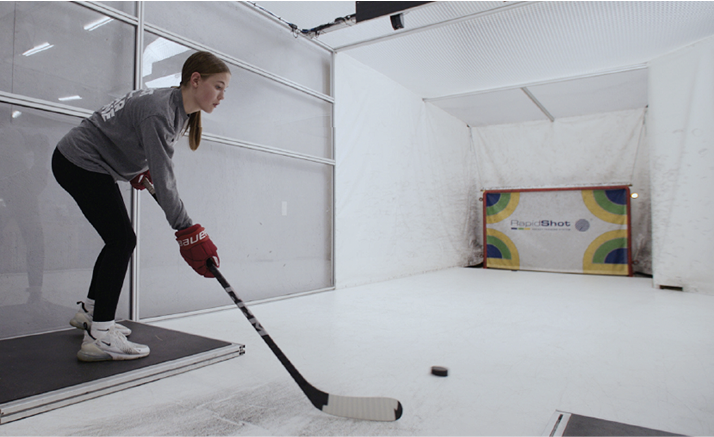
For coaches and trainers looking to accelerate skill development and produce measurable results. Here’s a number that should bother every hockey coach: during a typical team practice, the average player takes fewer than 20 shots. Think about that. An hour of ice time. A 17,000-square-foot rink. A full coaching staff. And a player might release the puck at the net fewer than 20 times. The rest of the session is spent on transitions, waiting in line, skating drills, and chasing down pucks between reps. Now compare that to what’s possible in a dedicated shooting lane: over 200 shots in 15 minutes. Every one of them preceded by receiving a pass. Every one of them tracked for speed, accuracy, and release time. Every one of them building the muscle memory that shows up when it matters most: in a game. The gap between those two numbers isn’t just an efficiency problem. It’s a development problem. And it explains why coaches who have embraced high-volume, data-driven shooting training are seeing their players improve faster than they ever thought possible.
The Science Is Simple: More Reps, Faster Learning
Motor learning research has been consistent on this point for decades. Skill acquisition is driven by three factors: the volume of deliberate practice, the immediacy of feedback, and the consistency of the training stimulus over time. A player who takes 200 tracked shots in a focused 15-minute session, with real-time data after every rep, is operating in an entirely different development environment than a player who takes 20 untracked shots scattered across an hour of practice. This isn’t about replacing ice time. Team practice builds game sense, systems understanding, skating, and all the other dimensions of hockey that matter. But when it comes to the specific skill of shooting (developing a hard, accurate shot with a quick release) volume and feedback are what drive improvement. And traditional practice formats simply can’t deliver enough of either.
The Math: Driveway vs. Dedicated Training
Consider a motivated player who wants to complete 10,000 focused shots, a proven threshold for meaningful skill development. Here’s how the math plays out in two different scenarios:
Training in a driveway or garage: A player shooting on their own, collecting pucks manually with no passing, no targets, and no data, can realistically take about 30 shots in a focused session. Training three times per week for three months, that player accumulates roughly 1,000 shots. To reach 10,000, they’d need about 160 hours of total training time spread over a much longer period.
Training on an automated shooting lane: With a system that passes, collects, and tracks automatically, a player can take 300 or more shots in a single session. At the same three-times-per-week frequency over three months, that’s 10,000 shots, and it takes roughly 16 hours of total training time. That’s a 10x difference in efficiency. Same commitment from the player, radically different output. And the shooting lane version comes with something the driveway never provides: data on every single rep.
What the Data Actually Shows
The real question for any coach isn’t “can players take more shots?” It’s “does taking more shots actually produce better players?” The data answers that clearly. Across a dataset of more than 130 million tracked shots taken by over 50,000 athletes, the pattern is unambiguous: consistent, high-volume training on a system that measures performance produces rapid, measurable improvement across every age group.
The 50-day threshold. Players who train consistently for 50 days reach the 90th percentile or higher for their age group, on average. Not the players who were already talented. The average player who commits to the work. After just 10 days of training, players see an average 90% improvement in their overall score. By 50 days, that improvement reaches 250%. By 100 days, it’s 300%.
It works at every age. The improvement curve holds across the full development spectrum:
- Atom (9-10): Baseline score of 8 → 70 after regular training (775% improvement)
- PeeWee (11-12): Baseline of 18 → 152 after regular training (744% improvement)
- Bantam (13-14): Baseline of 32 → 199 after regular training (522% improvement)
- Midget (15-17): Baseline of 56 → 320 after regular training (471% improvement)
- Junior (18-19): Baseline of 86 → 374 after regular training (335% improvement)
Even infrequent users (players who trained fewer than 20 days) showed meaningful gains. But the difference between infrequent and regular users is dramatic. Consistency compounds.
What “Better” Actually Looks Like
Aggregate data tells one story. Individual player journeys tell a more vivid one. Here are three examples from real training programs:
A 14-year-old who committed to the process. Over four years and 95,000 shots, this player improved his overall score by 312%, from a baseline of 56 points to over 316. His accuracy climbed from 51% to 83%. His shot speed increased by 6 mph. And perhaps most importantly for game translation, his release time dropped from nearly a full second to 0.46 seconds. That’s the difference between a shot that gets blocked and a shot that beats a goalie.
A 16-year-old who trained for 50 days. Over 9,200 shots, his accuracy jumped from 39% to 88% and his shot speed increased by 15 mph. His overall score nearly quadrupled.
A 13-year-old with 100 days of training. His accuracy went from 31% to 65%, his shot speed reached 42 mph, and he cut his reaction time in half, down to 0.5 seconds. These aren’t outliers. They’re representative of what happens when players commit to high-volume, measured practice. As one facility operator put it: “It’s making kids want to shoot pucks versus being forced to.” And at the highest level, one RapidShot-trained athlete who logged over 10,000 shots on the system went on to win a D1 national championship, scored the game-winning goal, and earned a roster spot on the US Olympic team.
Why This Matters for Your Program
If you’re a coach or trainer, the implications are practical:
You can establish real baselines. The first session on a tracked shooting system gives every player an objective starting point: shot speed, accuracy by corner, reaction time, and an overall composite score with a percentile ranking against their age group. That baseline becomes the foundation for a personalized training plan, the same way a strength coach would baseline a squat or bench press before building a lifting program.
You can identify specific weaknesses. Aggregate accuracy doesn’t tell the whole story. A player might hit 70% overall but only 40% to their backhand-side top corner. A system that tracks accuracy by zone gives you and the player a specific area to work on, not just a general directive to “work on your shot.”
You can show progress objectively. Every coach has had the conversation with a parent or a player: “Am I getting better?” With tracked training data and automated performance reports that go directly to players and parents after every session, the answer is never subjective. The numbers either moved or they didn’t. This changes the quality of your coaching conversations and builds trust in your program.
You can supplement, not replace, your coaching. The highest-performing programs use a combination of coached sessions and independent player training. A coach might run a baselining session with a new player, reviewing their initial data, providing technique instruction, and establishing goals. The player then trains independently between coached sessions, building reps and tracking progress. The next coached session starts with data, not guesswork.
You can create competitive energy. When players can see how they rank against peers in their age group, and when two players can go head-to-head in real time, training stops being a chore and starts being a competition. Facility operators consistently report that the competitive element is what drives repeat usage. Players come back because they want to beat their own score, beat their teammate, or climb the rankings.
The Coaching Multiplier
Here’s the part that doesn’t show up in the data but every experienced coach understands intuitively: a player who takes 10,000 tracked shots develops a fundamentally different relationship with their shot than a player who takes 1,000 untracked ones. The high-volume player has internalized the mechanics. They don’t think about their release. It’s automatic. They’ve built the neural pathways through sheer repetition, and they’ve refined those pathways through immediate feedback. When they step on the ice for a game, they’re not trying to shoot well. They’re executing what their body already knows. That’s the promise of high-repetition training with real-time data: it compresses the development timeline. It takes the years of unstructured practice that used to be required and turns them into months of focused, measured work. The players who are getting more ice time and winning more games are the ones who showed up and put in the reps. The technology just makes sure every rep counts.
RapidShot’s automated training system has tracked over 130 million shots across 50,000+ athletes in more than 200 locations worldwide. To learn how RapidShot can integrate into your training program, request a quote or contact our team.


